

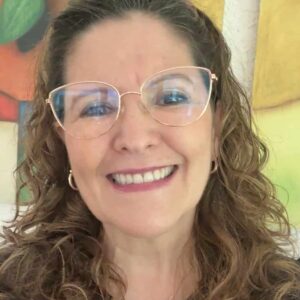
Monica’s path to health coaching began unexpectedly when she joined a functional medicine clinic in northern Mexico and discovered a passion for helping patients uncover the root causes behind their health concerns. Encouraged by one of the clinic’s doctors to apply for the Functional Medicine Coaching Academy’s Community Impact Scholarship, Monica entered the program without fully realizing that the work she already loved was, in fact, health coaching. As a member of FMCA’s August 2024 class, she found herself deeply inspired by the program’s coaching tools, collaborative cohort experience, and the opportunity to learn from leading experts in functional medicine and behavior change. Monica especially connected with the concepts of positive psychology and tiny habits, which she now uses to help clients integrate sustainable lifestyle changes into their daily lives.
“This course changes your life and the way you see health because you stop looking only at symptoms and start truly seeing the person.”
Monica Aguilar Alvarez, FMCHC, NBC-HWC
Today, Monica works both within a functional medicine clinic and through her own practice supporting families who have a loved one with a disability, a mission deeply informed by her personal experience as the mother of a son with Down syndrome. Drawing from both lived experience and her FMCA training, she helps caregivers prioritize their own wellbeing alongside the care they provide to others. Monica credits FMCA’s alumni resources, particularly the “How to Get Started Working as a Health Coach” workshop, with helping her define her niche and build a practice aligned with her purpose. Reflecting on her experience, she shares that FMCA transformed the way she views health and healing by teaching her to see beyond symptoms and truly understand the whole person. She also emphasizes the supportive nature of the FMCA community, describing it as a place filled with generous, compassionate people who are always willing to guide and encourage one another.
Watch the Interview
Watch the full FMCA Alumni interview with Monica to learn more about her inspiring journey:
Meet Monica
Monica Aguilar Alvarez,
FMCHC, NBC-HWC
Mónica has a passion for helping people reach their utmost potential. She specializes in the inclusion of people with disabilities and works as a volunteer with pregnant women in a state of vulnerability. Mónica also uses her masters in family sciences to advocate for family values. A longtime follower of Functional Medicine, it was her own experience with cancer that called her to help others take control over their health through healthy lifestyle changes.
Connect
Transcript
Natalie: Hello, everyone. My name is Natalie. I’m on the marketing team with FMCA, and I’m very excited today to be with Monica. She is working as a health coach for four years in Mexico, and she specializes in functional medicine. She works within a clinic, and she also has a personal practice in which she helps to support families who have a member with a disability. She has a certification in positive psychology and a master’s degree in family science. Monica was a member of the August 2024 FMCA class, and she was a recipient of the FMCA Community Impact Scholarships. So, Monica, I’m very excited to be with you today. Thank you for being here.
Monica: Thank you, Natalie, for inviting me.
Natalie: So, first, I would love if you could tell me what you were doing before becoming a student at FMCA.
Monica: Well, I started working in this clinic at the north of Mexico, and I really didn’t know very well what I was doing. So, I was very grateful to becoming a student in FMCA.
Natalie: And so, what brought you to functional medicine and ultimately health coaching?
Monica: It is like a random story because I knew that the doctors who founded the clinic Integrale at the north of Mexico, and they invited me because they saw something in me. I didn’t really realize that I…what I was going to do, but after I started, I found out that looking for the cause, the root cause of everything that was happening with the patients of the clinic was wonderful. And I didn’t know that what I was doing was coaching. So, when I entered FMCA, I learned a lot. I had the tools to do what I love to do that I didn’t know that I loved it.
Natalie: That’s so interesting. And so, how did you actually find FMCA and the scholarship opportunity? How did it come about in your life?
Monica: Well, one of the doctors… I didn’t know anything about health coaching. So, one of the doctors said, “Monica, I think you have to learn a little bit more. So, there’s this scholarship. Why don’t you apply to it?” So, I said, well, the boss is telling me to apply to something. So, I have to do it even if I don’t earn it. Right? So, that’s the… I wrote it. I sent it. I really didn’t know what I was applying to, but it turned to be a wonderful experience.
Natalie: That’s so beautiful. It was just meant to be.
Monica: Yes, that’s right.
Natalie: Yeah. And so, how are you using your health coaching certification to enhance what you were doing before and making impact on the health and wellness of your clients and your community and the families that you work with?
Monica: Well, in the clinic, I know that I don’t have the ultimate care of the patients, but I guide them through all the doctors and all the professionals, medicine professionals that they go to. So, I follow through the whole program. And what I like the most is positive psychology and the tiny habits that we talk about in FMCA and how to get to do what the specialists tell them to do in their daily day, in their own habits, in their personal way of doing things. That’s what I really like to do.
Natalie: Yeah. That’s what makes coaching so special is that behavior change.
Monica: Exactly. Exactly. And with the families, with members with disabilities, I try to introduce health and caring. Parents, especially, we forget about us because I have a son with a disability. He has Down syndrome. So, I do not only coach from the coaching point, but from the experience point. So, I try to make them see that if they are okay, their children will be okay. So, it is only not the health point of view of the child or the adults, I don’t know, but the caregivers. So, it’s very interesting.
Natalie: Yeah. To pour into your own cup, to be able to really support your loved one. Totally.
Monica: Exactly. Exactly.
Natalie: And so, I’d love to go more back to your experience at FMCA. So, can you tell me about your experience as an FMCA student, and what did you enjoy most about the program?
Monica: I think that I enjoyed the coaching part. I really enjoyed all the tools that they gave us, the opportunity to coach among the people in my group. I learned a lot from them. Some of them were already experienced, some of them were not. And the tolerance, the friendship, to know that all of us were learning and trying to learn from each other, that was very nice.
Natalie: Yeah. The cohort is what really makes FMCA so special is that live experience to practice coaching with the other students.
Monica: Yes.
Natalie: And so, how did FMC prepare you to be a successful health coach? Are there any particular tools that you learned or pieces of the curriculum that you can recall?
Monica: Yes. Especially I want to say that the level of the whole course is really, really, really high. The people who are teaching us all the curriculum is really high. So, I didn’t expect that. We had very, very specialized people who were talking to us and teaching us the timing that you could really take your time on your own space, on your own time. That was wonderful. That you could really specialize in what you liked. And what else? Those are things that I really liked. And one thing that I appreciate a lot is that you can download the curriculum and see it later, once and another time and another time and another time. So, I am still studying from my course from last year, and I go back to the courses. And I think that’s very rich for me.
Natalie: And so, this leads perfectly into my next question. So, we say that you’re an FMCA graduate for life. And what does that ongoing alumni connection and support look like for you? You mentioned that you love to look back at the curriculum that you have as an alumni. But what else is there that has been really important to you as being an FMCA graduate?
Monica: Well, I got enrolled with the alumni program. So, this course that gave us how to start to be a coach, I don’t know the whole name, but I think that was fantastic. That really hit me on my heart, on my face, on what I wanted to really do. So, I had to stop a little bit and know who I was, what I wanted to do as a health coach, what my niche was going to be. And that’s how I became and…or I started doing my personal practice, because I…that was me, helping families and parents with children or a member with disability. That was me. But it took me a while to find out what I wanted really.
Natalie: What your niche was.
Monica: Exactly. And how I wanted to serve.
Natalie: Yeah. So, you’re referring to our how to get started working as a health coach workshop.
Monica: Exactly.
Natalie: Exactly what it is. It says it in the title. So, it really just helps you figure out what your goals are, who you are as a health coach, and how you can really get started making a difference and transforming the lives around you. I’m so happy to hear that that was helpful in your career.
Monica: It was hard. It was really hard. It is not easy to know to build a new person, a new server. You know, it’s really hard. And it took me a while.
Natalie: Well, I think all challenges in life bring something really beautiful in the end. So, it should be hard. Yeah.
Monica: Yes.
Natalie: And so, I would love to know, what would you say to someone who is considering embarking on the journey to becoming a functional medicine certified health coach?
Monica: I would say that this course changes your life and the way you see, I would say, illnesses, but not really. Because everything goes deep, deep, deep, profoundly to the roots. And it’s not only the symptoms that you are going to see, but the person and get to know the person internally and personally. So, you can transform that life. So, your view, your point of view about medicine, about coaching, about what is it that is causing the illness, it’s going to change completely. You have… I’m sorry.
Natalie: No. I just said that was so beautifully put and well-articulated.
Monica: I was going to say that you’re going to spend a lot of time learning, but a very, very rich course and very complete. It has everything. You can specialize in whatever you like to be. And you will meet people who are very, very intelligent and who have been in this field for years, or you can meet people like me that we didn’t…that we don’t know anything about it.
Natalie: That’s wonderful. Well, thank you so much, Monica. Do you have anything else that you would like to add or say to any future FMCA students or the FMCA community?
Monica: Well, I have found that all the people in FMCA is really nice. I think it’s…they have chosen them because they are giving and they are beautiful inside and outside, and that if you reach, you can always have an answer, and that the founder, Dr. Sandi, is still there and still teaching and still giving and answering one and second time and third time the same questions that we have. And that, I appreciate a lot. It’s a very, how do you say, containing team?
Natalie: Supportive community?
Monica: Exactly.
Natalie: Yeah. That’s exactly what we want to be. And so, we’re so grateful to have you as part of our FMCA community.
Monica: Thank you.
Natalie: And thank you so much for taking the time to speak with me today, Monica.
Monica: Thank you, Natalie.
Our Latest Blogs
-
Celebrating 200 Episodes of Health Coach Talk: Our Top 10 Favorite Conversations
Read Full Article: Celebrating 200 Episodes of Health Coach Talk: Our Top 10 Favorite Conversations -
Labs, Supplements, and Legal Liability: Where Coaching Ends and Practicing Medicine Begins
Read Full Article: Labs, Supplements, and Legal Liability: Where Coaching Ends and Practicing Medicine Begins -
From College Student to Functional Health Coach: Maria Falcon, FMCHC
Read Full Article: From College Student to Functional Health Coach: Maria Falcon, FMCHC
