

A few years ago, continuous glucose monitoring (CGM) didn’t really come up in health coaching sessions unless a client already had a diabetes diagnosis and a prescription. But since the FDA cleared the first over-the-counter continuous glucose monitor in 2024, that has shifted.
Today, adults without diabetes can buy a sensor at a pharmacy or online with no prescription and no diagnosis required. Clients are showing up to coaching with devices, screenshots, and questions, and coaches need up-to-date knowledge of what these devices measure and where their own role begins and ends.

What Is a Continuous Glucose Monitor?
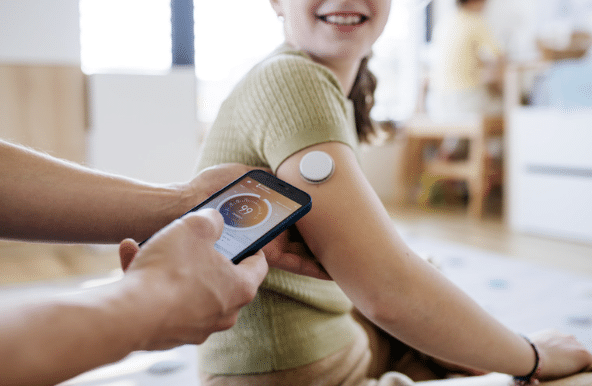
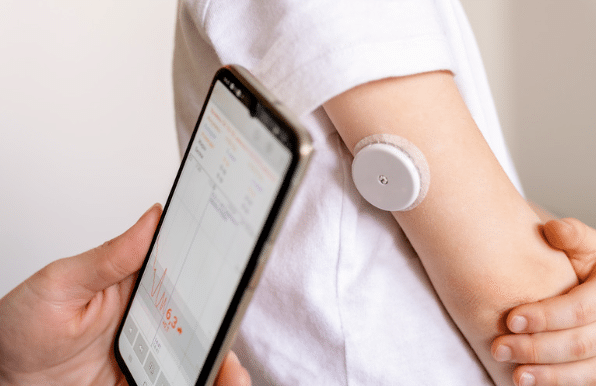
A continuous glucose monitor is a small sensor, usually worn on the back of the upper arm or the abdomen, that measures glucose in the interstitial fluid just under the skin. It sends a reading to a paired app on a set schedule, and because the sensor is reading fluid outside the bloodstream, there’s a lag of roughly ten to fifteen minutes between what a fingerstick test would show and what the CGM displays. That lag is most noticeable when glucose is changing quickly, such as right after a meal or a workout.
How CGMs work:
- Lag time: Roughly 10 to 15 minutes behind blood glucose, most noticeable during fast changes
- Sensor placement: Adhesive patch on the back of the upper arm or abdomen, replaced every 10 to 15 days depending on the device
- What it measures: Glucose in interstitial fluid, not a direct blood draw
- Data delivery: Bluetooth connection to a smartphone app or dedicated reader
- Reading frequency: Every 1-15 minutes, depending on the device
- Variability: Two people can eat the same meal and see different curves, since factors like genetics and gut microbiome composition play a role in how glucose responds
Most Popular CGMs in 2026
Here’s what clients are most likely to bring up, and what a coach should know about each one.
| Device | Prescription Required | Wear Time | Cleared For | Primary Use Case |
| Dexcom G7 | Yes | ~10 days | People with diabetes (type 1 and type 2) | Immediate high/low alerts and insulin-dosing support |
| Abbott FreeStyle Libre 3 | Yes | ~14 days | People with diabetes | Continuous tracking for diabetes management |
| Dexcom Stelo | No | ~15 days | Adults 18+ with type 2 diabetes not on insulin, and adults without diabetes seeking general insight | Cash-pay glucose tracking with a broader measurement range |
| Abbott Lingo | No | ~14 days | General adult wellness use, 18+, excluding people with diabetes | Guided in-app coaching and habit-building insights |
| Abbott Libre Rio | No (cleared, not yet available) | ~15 days (expected) | Adults 18+ with type 2 diabetes not on insulin | Not yet commercially launched as of 2026 |
Stelo and Lingo are both over-the-counter, but they are meant for different clients. Stelo’s cleared population includes adults with type 2 diabetes who aren’t on insulin, whereas Lingo is built strictly for wellness use and excludes anyone with diabetes. When you’re working with a client on which device fits their situation, start with the health goal they’re managing (and as always, when in doubt, refer them to their practitioner).
Price and Insurance: How Much Do CGMs cost?
- Prescription CGMs (Dexcom G7, Libre 3) are often covered by insurance for people with a diabetes diagnosis, particularly those using insulin
- OTC CGMs (Stelo, Lingo) are cash-pay, though HSA and FSA funds typically apply
- OTC pricing generally runs $50 to $90 per sensor, with subscription plans that lower the per-sensor cost
- Coverage and pricing shift often enough that clients should confirm current numbers with their insurer or pharmacy
3 Popular CGM Coaching Platforms: Levels, Nutrisense, and Theia Health
Some clients pair their CGM with a subscription coaching app of their own, and some coaches use a platform to bring CGM into their practice. These three platforms come up most often:
| Platform | Primary User | How It Works | Key Features |
| Levels | Individual consumers | Connects to a compatible CGM, often Stelo | Food logging, a proprietary metabolic score, educational content |
| Nutrisense | Individual consumers | Pairs with a CGM | Food and glucose tracking, plus access to human dietitians and coaches |
| Theia Health | Coaches, nutritionists, and other wellness providers | Handles prescription fulfillment and sensor delivery on the provider’s behalf; supports several common models including Libre and Dexcom G7 | Food-photo meal logging, a daily metabolic score, group features for cohort challenges |
It helps to know which parts of the experience come from the app itself and which come from a person. With Levels and Nutrisense, your client is the end user, so any coaching you add is layered on top of what they’re already getting. Theia Health works differently, since it connects a prescription pathway directly to a coaching relationship. Knowing the type of support each platform provides can help you focus your own time and attention where it counts.
What Is Non-Invasive Glucose Monitoring?
Non-invasive glucose sensing, meaning glucose tracking without any needle or skin-piercing sensor, is an active research area. Several approaches are in development, including optical sensors, radio-frequency sensors, and smart rings that estimate glucose from other physiological signals.
As of 2026, no non-invasive device has FDA authorization for glucose measurement, and accuracy in published testing still lags well behind approved CGMs. This is useful context if a client brings up a wearable they’ve seen online, because as of today, none of it is ready for a coach to recommend.
6 Ways Health Coaches Support Clients Using CGMs
Outside of diabetes management, CGM data shows the clearest benefit for clients with prediabetes or those working on metabolic health or weight management. For these clients, the data can reveal how daily habits affect glucose trends over time. If you’re a health coach working with these populations, here’s what you need to know.
Coaches do meaningful work with CGM data, mostly centered on helping clients reflect on daily habits and turn that reflection into lasting change:
- Educating: Offering general, evidence-based information about what glucose is and how CGMs work
- Reviewing trends together: Looking at a week of readings and reflecting on meals, sleep, and activity logs
- Connecting data to behavior: Support conversations about meal composition, timing, or stress using the data, not judgments about the food itself
- Building better questions for the care team: Helping a client prepare specific questions before a doctor’s appointment
- Educating on variability: Educating clients on the way glucose naturally fluctuates throughout the day
- Setting tracking boundaries: Helping a client decide how often to check the app so tracking supports the goal instead of becoming the goal
As always, coaches help clients process information their care team has already reviewed. Diagnosis and treatment decisions stay with the client’s clinician.
Navigating CGM Data Risks for Non-Diabetic Clients
Not every client will use CGM data in a helpful way, and coaches are well positioned to catch a few specific risks early.
CGM readings for people without diabetes haven’t been validated with the same rigor as they have for people managing the condition, so for non-diabetic CGM users, a single unusual number carries less weight than it might seem to. A glucose spike after a meal is a normal physiological response, and treating every spike as an alarm can push a client toward unnecessary restriction. The sensor lag mentioned earlier compounds this: a reading taken right after a fast-digesting meal or a workout may not accurately reflect where glucose settles a few minutes later.
For clients with a history of disordered eating or a tendency toward rigid food rules, CGM data can become another tool for restriction. If tracking starts to increase anxiety around food rather than build understanding, that’s a signal to scale back the data and refocus on the client’s relationship with eating, potentially with a referral to a specialist.
Responsible-use checklist:
- Confirm client understands lag time and normal variability before reacting to a single reading
- Watch for trends, rather than fixating on any single reading
- Notice if tracking increases anxiety or rigid food rules, especially with clients who have a disordered eating history
- Steer client away from labeling specific foods as good or bad based on a glucose reading
- Keep OTC device accuracy limitations in mind, particularly outside a diabetes diagnosis
- Treat a concerning pattern, like frequent lows or unexplained highs, as a referral trigger, not an ongoing coaching topic
Continuing Education: Metabolic Health Coaching Course
Coaches who want a deeper foundation can pursue continuing education in metabolic coaching and glucose tracking. Two FMCA graduates built a course on this topic: Metabolic Health Coaching With a Continuous Glucose Monitor (5 CEs). It covers glucose tracking and metabolic health in more depth and is a strong fit for coaches who plan to work with clients who use CGMs. Find full course details and registration information here.
Frequently Asked Questions
Bringing CGMs Into Your Coaching Practice
CGM use is only becoming more widespread, so coaches can expect clients to keep bringing questions into coaching sessions, sometimes before you even raise the topic. The most useful habit you can adopt is to stay in the educator and supporter role, and loop in the client’s care team for anything outside that scope. FMCA’s health coach certification program builds that foundation, giving you the skills to help clients make lasting changes that meaningfully improve their lives.
Our Latest Blogs
-
Celebrating 200 Episodes of Health Coach Talk: Our Top 10 Favorite Conversations
Read Full Article: Celebrating 200 Episodes of Health Coach Talk: Our Top 10 Favorite Conversations -
Labs, Supplements, and Legal Liability: Where Coaching Ends and Practicing Medicine Begins
Read Full Article: Labs, Supplements, and Legal Liability: Where Coaching Ends and Practicing Medicine Begins -

From College Student to Functional Health Coach: Maria Falcon, FMCHC
Read Full Article: From College Student to Functional Health Coach: Maria Falcon, FMCHC
