

When you graduate from the Functional Medicine Coaching Academy (FMCA), you’re prepared to support clients at every stage of their well-being journey.
Whether you’re working alongside a doctor, on a collaborative care team, or in your own independent coaching practice, your FMCA training equips you to create lasting change through a blend of science, coaching skills, and compassion.
With the ability to meet clients where they are, you can coach confidently in any setting and build a career that reflects both your strengths and your clients’ needs.

Coach Confidently in Every Setting
There’s no ideal client or “one right way” to use your functional medicine health coach training. The program’s comprehensive curriculum provides the coaching skills needed to be effective, no matter where and how you choose to work.
FMCA graduates bring their skills to a wide range of environments, from private practice and entrepreneurial paths to healthcare teams, corporate wellness programs, and beyond. Many choose to coach independently, working one-on-one with clients who want to improve energy, reduce stress, or build sustainable habits. Others partner with doctors, nutritionists, or therapists to provide comprehensive collaborative support.
It’s no surprise that so many doctors prefer to collaborate with FMCA-trained coaches—their professionalism, communication skills, and science-based approach make them trusted partners in patient care. But that same depth of training also equips graduates to excel in independent practice, helping clients directly through one-on-one coaching and lifestyle change.
Whatever direction you take, the foundation is the same: empowering clients to make meaningful lifestyle changes that support health and well-being, whether or not a doctor is part of their care team.

Want to learn more about health coaching career paths? Read our blog post here.

The Full Spectrum of Health: From Sick Care to Well Care
Health doesn’t start or stop at the doctor’s office, so health coaching shouldn’t, either. What’s the difference between a doctor and a health coach? Read our article here.
That’s why functional medicine health coaches bring a broader perspective than you’ll find in the conventional healthcare system. They’re trained to view health holistically, not just as the absence of illness but as the presence of wellness.
Dr. John Travis’s Illness-Wellness Continuum illustrates this approach, depicting health along a spectrum, from disease management on one end to optimal vitality—physically, mentally, emotionally—on the other.
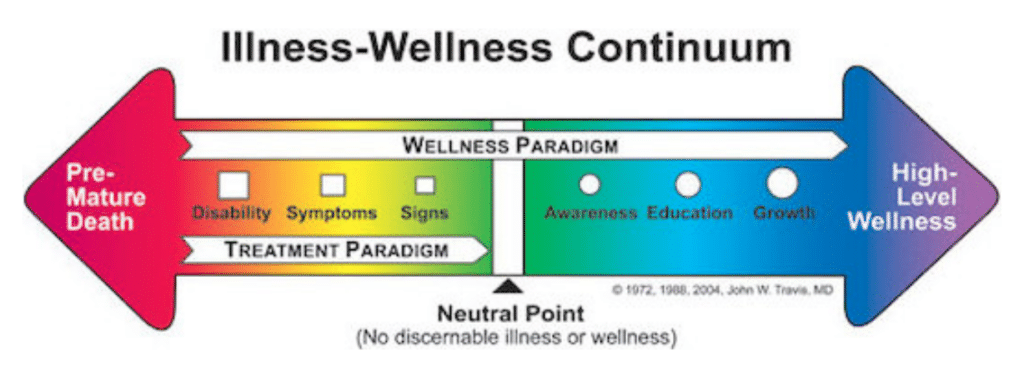
FMCA coaches make a meaningful impact at every stage of this continuum. Their training emphasizes the modifiable lifestyle factors proven to influence long-term health, including nutrition, movement, sleep, stress management, relationships, and mindset. This holistic background prepares them to support clients across the spectrum, from those managing an illness under medical supervision to those pursuing wellness on their own.
And it works! We keep a running list of 100+ Studies that Show Health Coaching Works.
In the chart below, we see how Dr. Travis’s model applies to functional medicine health coaching, with the coach working across the spectrum to bridge traditional care and proactive wellness.
The Health Coach’s Role on The Illness-Wellness Continuum
| Aspect of Health | Sick Care | Well Care | The FMCA Coach’s Role |
| Where is the focus? | Treating illness and managing symptoms | Promoting vitality and preventing disease | Coach helps clients build sustainable habits and reach personal wellness goals |
| Who’s the primary guide? | Physician or healthcare provider | Client empowered to drive the process | Coach partners with clients to identify and act on changes that improve daily life |
| When do they take action? | Reactive, addressing conditions as they arise | Proactive, cultivating health before problems develop | Coach helps set goals and encourages awareness, accountability, and consistent action |
| When is the health coach brought in? | When the patient is under a doctor’s care, and typically until symptoms are under control | Anytime the client feels motivated to make a change; may or may not include working with a doctor | Coach supports clients in both scenarios, collaborating seamlessly with healthcare providers when needed and coaching independently on lifestyle change, prevention, and overall well-being |
FMCA coaches bring science-based knowledge and empathy-driven care that complements medical treatment when it’s needed and empowers clients to thrive independently when it’s not.
Let’s take a deeper look at the types of clients a coach might work with beyond the doctor’s office.
Types of Clients Functional Medicine Health Coaches Can Support
Coaching Clients Who Want to Feel Better, Not Just “Not Sick”
Many people today fall into a gray area: they’re not sick, but they’re not truly well, either. FMCA coaches help bridge the gap between “fine” and “thriving” by guiding clients to uncover what’s holding them back—stress, poor sleep, inconsistent nutrition, low energy—and make gradual, sustainable improvements.
These clients often seek coaching to feel better in their daily life. Together, coach and client identify meaningful goals and develop a plan to achieve them, with the coach offering accountability, education, and encouragement along the way.
Most of these clients aren’t under a doctor’s care; they’re pursuing their own wellness goals independently, with the support of a coach trained to help them create lasting, positive change.
Supporting Clients Who Feel Let Down by Conventional Medicine
Some clients turn to coaching because they feel dismissed or ignored by conventional medicine. These clients may still be struggling with health concerns but no longer feel comfortable seeking care within the traditional medical system.
For these individuals, a Functional Medicine Health Coach can be an essential and compassionate ally in rebuilding trust in the healing process. Coaches listen deeply, validate the client’s experience, and help them take constructive steps forward. That might include:
- Refining daily habits
- Clarifying and setting goals
- identifying and connecting with healthcare practitioners who align with their values
- Preparing questions to ask a doctor
- Practicing self-advocacy in preparation for a future medical visit
- Managing fears and anxieties with mind-body techniques
- Reclaiming confidence in their ability to make health-supporting choices
FMCA coaches help these clients regain a sense of agency and hope, while always maintaining empathy, professionalism, and clear boundaries.While these two examples illustrate common scenarios, FMCA coaches support clients in many other contexts as well. The chart below provides an overview of this full range.
Types of Functional Medicine Health Coaching Clients
| Type of Client | Typical Situation | What Functional Medicine Health Coach Might Look Like |
| Sick client under a doctor’s care | Actively managing a medical condition | Collaborate with healthcare team, support behavior change, encourage adherence to treatment, provide lifestyle guidance |
| Healthy client with specific wellness goals | Want to improve fitness, nutrition, sleep, or stress | Coach goal-setting and habit-building. Track progress and provide accountability to reach measurable outcomes |
| Client seeking general wellness improvements | Want to feel better overall but not seeing a doctor | Guide lifestyle improvements, support awareness and accountability, promote proactive wellness |
| Client who feels let down by conventional medicine | Have health concerns but avoid or distrust doctors | Listen, validate experience, help articulate goals, explore lifestyle changes, facilitate self-advocacy, and assist in finding trusted practitioners |
| Client seeking preventive care | Interested in avoiding future health issues | Educate on modifiable risk factors, develop preventive strategies, support sustainable habits |
FMCA Health Coaches: Prepared for Every Stage of Health
FMCA graduates are trained to coach confidently in any setting, drawing on a foundation in functional medicine, positive psychology, and behavior change science. Whether supporting preventive wellness, complementing a doctor’s care, or helping clients rebuild trust in the healing process, FMCA coaches bring science-based knowledge and empathy-driven support that helps people feel and live better.
Our Latest Blogs
-
Celebrating 200 Episodes of Health Coach Talk: Our Top 10 Favorite Conversations
Read Full Article: Celebrating 200 Episodes of Health Coach Talk: Our Top 10 Favorite Conversations -
Labs, Supplements, and Legal Liability: Where Coaching Ends and Practicing Medicine Begins
Read Full Article: Labs, Supplements, and Legal Liability: Where Coaching Ends and Practicing Medicine Begins -
From College Student to Functional Health Coach: Maria Falcon, FMCHC
Read Full Article: From College Student to Functional Health Coach: Maria Falcon, FMCHC
