Modern Flour and the Missing Piece of the Gluten Conversation, With Jill Brockman-Cummings
Could the way wheat is grown and processed matter as much as the grain itself? This week on Health Coach Talk, Dr. Sandi welcomes Jill Brockman-Cummings, mill manager at Janie’s Mill, for a fascinating conversation about organic farming, stone-milled flour, ancient and heritage grains, and the traditions that have largely disappeared from the modern food system.
“I know there are people with gluten intolerance. But I think, more often than not, people find that it wasn’t the wheat… It wasn’t the grain. It was how the wheat was grown. It was how the wheat was processed. It was what was put into the flour to preserve it, to leach it. All of those things are unnatural.”
Jill Brockman-Cummings
Jill entered the world of milling without formal experience after organic farmer Harold Wilken invited her to help build and operate an organic stone mill in East Central Illinois. Beginning as Janie’s Mill’s only employee in 2017, she learned through research, experimentation, and conversations with bakers how to transform locally grown organic grains into flavorful, versatile flours. She explains how stone milling preserves the grain’s germ and portions of its fiber-rich bran, while conventional roller milling typically separates these components to create refined white flour. Jill also discusses sourdough fermentation, the different baking properties of spring and winter wheats, and the unique flavors and nutritional qualities of ancient grains such as einkorn and black emmer.
For health coaches, this conversation offers a more nuanced perspective on the growing fear surrounding wheat, gluten, and grains. Jill emphasizes the importance of considering how a grain was grown, milled, fermented, and prepared while recognizing that people with celiac disease must strictly avoid gluten. Her work illustrates how coaches can encourage curiosity, individual awareness, and informed food choices rather than relying on broad assumptions about entire food categories. Listen to the episode for a closer look at how regional agriculture, thoughtful processing, and a return to traditional foods may help people develop a more nourishing relationship with grains.
Watch The Episode
Episode Highlights
- Examine what happens to the germ and bran during conventional roller milling
- Explore how organic farming and harvesting practices may influence the final flour
- Learn why ancient grains can contain high protein without producing strong gluten structure
- Understand how health coaches can bring greater nuance to conversations about wheat and gluten
Special FMCA Discount:
As a Health Coach Talk listener, receive 10% off your first Janie’s Mill order with code FUNMED10. Valid for one purchase per customer.
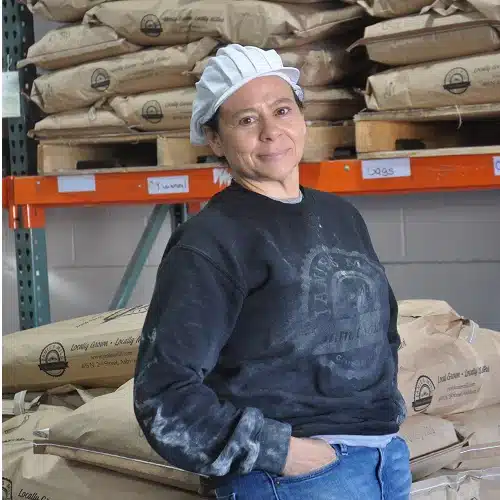
Good food, especially bread, became an important part of my life after I spent a year abroad in Luxembourg when I was in high school, and then a semester abroad in France when I was in college. Unbeknownst to me at the time, that was the beginning of my desire to be part of the good food movement. This desire continued as I was raising my four daughters in the rural midwest, surrounded by conventional farms spraying agrichemicals. So when my organic farmer neighbor Harold Wilken drove up one day and asked if I’d like to be a miller at the organic mill he was thinking of building, I jumped on it.
Together we toured other small stone mills across the country, and eventually built Janie’s Mill where I am Mill Manager. In that capacity I run our certified organic stone-milling operation where we mill dozens of varieties of grains, most of which are grown just a few miles down the road on Janie’s Farm. I have managed all aspects of Janie’s Mill since its inception over 6 years ago, including strategic planning, day-to-day operations, monitoring quality of grains and milled products, developing new products, and working with both online retail and wholesale customers. I also participate in our regional Artisan Grain Collaborative and other groups to create and strengthen the Midwest Regional Grain Chain.
Connect
Listen Now
Transcript
Dr. Sandi: Are you avoiding wheat, or maybe you’re a health coach and you are talking to your clients about the issues with wheat, with gluten, with flours in general, with grains in general? Well, then you’re going to want to listen to the conversation that I have in this episode of “Health Coach Talk.” I am talking with somebody who is a mill manager. Her name is Jill Brockman-Cummings, and she is the mill manager at Janie’s Mill. And we had a fascinating conversation. I first met her at an event where I just learned all about milling and ancient grains, heritage grains as well as the issues with today’s processing of grains or processing of grains into flour. So, I know you will enjoy my conversation with Jill. Welcome to the podcast, Jill.
Jill: Thank you, and thanks for having me.
Dr. Sandi: Thank you. Well, you have a fascinating story on how you discovered organic farming, stone-milled in particular, in terms of grains. So, let’s start out by just saying how you arrived at Janie’s Mill, what that is.
Jill: Janie’s Mill is a organic stone-ground mill here in East Central Illinois. And it was the brainchild of Harold Wilken, who is an organic farmer right here near Ashkum, Illinois. He lives in Danforth, but it’s right next door. And about a little over 10 years ago, he came to me and said, would you like to run an organic mill? And I really had no prior knowledge of milling. I think the only reason he asked if I might be interested is he knew I like to bake bread. And he knew that I also was very invested in organic practices and the health of my family and my surrounding neighbors. And so, he thought, well, she’s already invested in the organic agriculture part of the business, and she likes to bake. So, maybe she would like to mill flour.
So, I took him up on his offer. And we began investigating, visiting other stone mills across the country to decide what Harold would like to build here. And that took place in 2015, 2016. The mill actually began in 2017, and we started very slow. I was the one and only employee in 2017. So, my task was to learn how to mill organic grains into different flours that bakers in our region and beyond would be able to use in their bakeries or their restaurants. And initially, we did want to just focus on our wholesale accounts.
But I didn’t really know where to begin other than I had the grains from Jamie’s Farm. I had the different types of organic wheat, and rye, and corn. And I just had to start trial and error milling to figure out how the mills worked, how to get an end product that was quality for our bakers.
Dr. Sandi: That is just a fascinating story. Most people don’t think about milling. So, they think, you just buy flour at the grocery store and of course have no idea what’s in it. And there are many advantages. Can you talk about the health advantages of a stone-milled flour?
Jill: Yes. Stone-milled flour is in opposition, I guess, to roller-milled flour, which most of us grew up with, buying white roller-milled flour from the grocery store shelves. And we didn’t really know any better. We didn’t really know there’s different varieties of wheat with different flavor profiles. We didn’t know there was ancient grains with more nutrition. I didn’t anyway know about all of these things until I got much older. And I actually didn’t even know about a lot of the benefits of stone milling until I got into this career.
So, with roller milling, the first thing that they do is they remove all of the germ within the kernel of grain. Now, the germ is where most of the nutrition lives, because that is like the embryo of the kernel of grain. That is what is…the energy within the germ is where the plant sprouts. So, they take that out because it’s comprised mainly of oils. And oils, of course, will go rancid over time. So, a roller mill removes that, and then they continue to remove all of the bran or the outer protective layers in that kernel. Those layers, of course, as we know, are mostly insoluble bran, which is very high in fiber and also minerals and a little bit of protein.
So, they remove that as well because people want a white flour, a flour that produces a light loaf of bread or baked good. But when they remove the germ and they remove the bran, you’re left with the starch, the white, just basically almost void of all nutrients except for a little bit of protein. So, they have to enrich the flour. By law, roller mill flour has to be enriched. So, they’re adding synthetic vitamins and minerals back into the flour to fulfill the requirements, the nutritional requirements.
On the other hand, we have stone mill, which we do here at Janie’s Mill. So, stone milling is the process of feeding grain into a stationary and a rotating stone. And in that process, the grain is crushed. When it is crushed, the first thing that happens really is the oils within the germ permeate all of the flour. So, all of our flours contain the germ. So, right away, you’re getting that nutrition. And along with that is a lot of flavor. Then as the grain continues to go across the stone from the center outward, then the bran is wrapped along with the germ. In that process, some of the bran is ground so finely that in stone milling, even if we wanted to remove all the bran, we wouldn’t be able to. It’s ground as fine as the flour, as the white flour.
So, there are instances where, here at Janie’s Mill, we will remove some of the bran and make like a lighter sifted flour. But all of the flours contain the germ and one of the bran. So, when you buy stone-milled flour and you bake with stone-milled flour, you’re getting all of the goodness of the whole grain, which is how our bodies evolved to digest whole grains and not just try to digest the white starchy part of the grain, which turns to sugar in our digestive tract.
So, with stone-milled flours, I can’t say it enough, you get the nutrition, but the star is the flavor. And our customers find that the different varieties of wheat have the different flavor profiles. And it’s just really fun to try different flours and different recipes, and see the just different…maybe it’s nutty, maybe it’s a little spicy, maybe it’s a little earthy flavors that come with those different varieties. But again, you are eating a whole grain. The benefits of that are the nutrition, but the glycemic index is what a lot of our customers are looking for. Because if you’re diabetic, you need to eat whole grains. So, you need to eat baked goods, and you can eat baked goods that are baked with stone-milled flours like Janie’s Mill.
Dr. Sandi: That is a great point because I think so many people are scared of grains. And they’ve been told not to eat grains, to go on carnivore or keto, and avoid grains entirely, myself included. I used to be huge in the ’80s and ’90s in terms of grain and brown rice, eating tons of grains and then went off it, and I’m now getting back. But it is, again…what I’m seeing is that people are afraid and often they are afraid of gluten. But then when they go to Europe, they’ll say, oh, I had a croissant and I was fine. So, can you comment on that? And is there a difference? And perhaps we should touch on glyphosate as well and the problem and I know you saw a problem with glyphosate in the farms in your area.
Jill: Yes. I mean, there’s so many things to talk about with that. But I guess we can start with the glyphosate. So, it is common in chemical farming or what I call industrial farming to apply glyphosate to crops like wheat and oats before harvest. So, in these huge plots of grain, mostly in the Western United States or Kansas, Nebraska areas and Western, they want the convenience of harvesting these enormous acreages of grains all at once. So, they’ll bring in their army of combines and they want to harvest it all in that one day or whatever. To do that, they need to make sure the entire field is dried down.
Now, in nature, some parts of a field might dry down sooner than other parts, especially in these huge fields. And before glyphosate, farmers would wait until the entire field was dried down or they would combine the parts that were dry and leave the other parts for another day. Nowadays, and most commonly, they apply glyphosate, which is an herbicide, which is a desiccant, which dries down the stems and the whole plant so that you can conveniently go in and harvest it all in one go.
But the downside of that is the glyphosate remains on the grains after harvest. They remain in the flour after it is milled, and then we ingest it. And an herbicide is…it means to kill plants, pesticide to kill pests. And in our gut, we have live organisms. Well, you’re pulling those off. And so, I agree with you. So many people were fearful of gluten, and gluten was the culprit, or bread was the culprit, whatever. But now, we’re starting to understand there’s probably many factors that we’re giving people lots of digestive issues. And that might and probably is one of the reasons that people have bloating, have extreme digestive problems when they eat grains or flours or baked goods that are baked with conventionally grown grains or conventionally rolled roller-milled grains. So, that’s probably one factor.
So, here at Janie’s Mill, everything is certified organic. Harold and his son, Roth Wilken, farm now almost 4,000 acres of farmland organically. And I just point out, most of that acreage, they do not own. They farm for over, I think, 30 landowners now. So, landowners come to them and say, “Would you please farm our land organically?” So, more and more people are concerned about the environment, concerned about industrial farming, chemical farming practices, and they’re looking for an organic farmer. And so, Janie’s Farm continues to take on more and more acreage to help out these landowners. And also, it helps us here at the mill because we need more and more small grains like wheat and rye.
So, that’s one point, is organic farming is very important because what we ingest nowadays is laced with all kinds of chemicals.
Another part to that is sourdough baking. So, sourdough baking kind of had a revival during COVID because so many people were interested in baking, and they get yeast and flour and that’s how they found us at Janie’s Mill because we never ran out. Where was I going with that? Help me, Sandra?
Dr. Sandi: With sourdough.
Jill: So, with sourdough baking, the benefits to that and our digestive tract and the health of our bodies is that it’s…you can consider it pre-digested. So, the fermentation process pre-digests that gluten. So, if you are gluten-sensitive, like some people are…and that’s nothing wrong with that. But if you bake with sourdough, then you have less of a chance of having maybe some discomfort or digestive issues because the sourdough process, the fermentation breaks down the gluten and pre-digests it. So, that is one of the benefits of sourdough.
So, so far, we’ve talked about organic farming and the importance of not having glyphosate or other chemicals in our food. We’ve talked about the sourdough benefit. But then along with that, of course, like we talked about before, the whole grain aspect. Again, our bodies evolved to eat whole grains, not to take out the germ, not to take out the bran. It’s a full grain. It’s a slower digestion. It’s a natural digestion. And for all of those reasons, stone milling does help a lot of people who previously thought they could no longer eat grains, flour, or gluten.
Dr. Sandi: This is such great information, and particularly for our health coaches who are listening. You can inform your clients and support them with trying these stone-milled grains and clarifying some of the myths that are out there. So, what are your customers saying, perhaps those who have gluten sensitivities or have been avoiding it and then now they are eating Janie’s Mill’s grains?
Jill: Well, it’s exactly like that story you told. We’ve heard from a lot of people who traveled to Europe and where some of these chemicals like glyphosate are not allowed, and they don’t have any problems. And so, lo and behold, we start to wonder what’s happening here. So, we hear those stories. We hear about people that, yeah, they say they haven’t eaten any baked goods made from wheat in 10 years. But then someone suggested that they tried just a little bit of our flour and see how they do. And will write to us and say, I’m using only your flour now. I’m not having any problems. I feel great. Everything’s good.
Now, let me just say, if you are celiac, do not even try to eat anything that is milled here at Janie’s Mill because wheat is everywhere. I mean, I encourage people. I’ll say, maybe if you’re worried and you want to try it, just continue with your diet, but try just the smallest bit that…bake even like a cookie with all-purpose flour and just take half of it and see how you do. I don’t want anybody to get sick. And I know there are people with gluten intolerance. But I think, more often than not, people find that it wasn’t the wheat. It wasn’t the wheat. It wasn’t the grain. It was how the wheat was grown. It was how the wheat was processed. It was what was put into the flour to preserve it, to leach it. All of those things are unnatural. All of those things hurt our bodies. And maybe not right away, but it’s cumulative as we get older. But you have to take care of your body even when you’re young, even when it’s more resilient than it is as we age.
Dr. Sandi: Absolutely. What are the varieties that you offer? So, you have wheat, whole wheat. But what else? There’s a rye and you have a high protein as well. Can you talk about what that is, what makes that particular one high protein?
Jill: Sure. So, our high-protein bread flour is milled from a hard red spring wheat. So, one of the first things I had to learn when I got into this was, what are the properties of different varieties of wheat? Well, there’s different categories of wheat, and one is spring wheat. Spring wheat is planted in the spring and has a high protein content. And in opposition to that, there are winter wheats that are planted in the fall, and those generally have lower protein content.
So, to mill our high-protein bread flour, I chose the blend wheat, which is grown by Janie’s Farm. Blend wheat is the variety, but it’s under the umbrella of hard red spring wheat. And that contains generally somewhere between 12.5% to 14% protein. So, that makes a really nice bread flour because it will…the structure of the dough is…the protein usually… to strong gluten strands. So, with high-protein bread flour, when you bake with it, your bread will rise. The gluten strands are very strong. So, they stretch and they rise, giving you that lighter, loftier loaf. So, that is our most popular flour, actually. And it’s used for focaccia, for bread, for pizza dough. It is not good for things like muffins or cornbread or a cake because you don’t want a high-protein flour for those things, or it’ll get very dense and stodgy.
So, we then have other varieties that have lower protein. So, for example, the second most popular flour we sell is all-purpose flour. And our all-purpose flour is milled from warthog wheat, which is the variety under the umbrella of hard red winter wheat. And that is a lower protein. And generally, at Janie’s Farm, it’s somewhere between 9% to 10%, which is low compared to bread flour. But that’s perfect for cookies. It’s perfect for breads or muffins or pancakes. And those things, you want the lower protein content. And warthog is beautiful for that purpose of all-purpose because it gives it a nice nutty flavor. So, people will bake chocolate chip cookies with our all-purpose flour. And they’re like, I had no idea they could just taste so good. And many people find they can reduce the sugar because they want to highlight the flavor of the flour now and not just have something that is so sweet. And that’s the flavor you get. Now, you get the flavor of the nuttiness. And it’s just amazing, actually, the differences.
But, yes. So, we have the usual flours that you might have been used to, like high-protein all-purpose. But then we have several heritage grains we mill. And we also have ancient grains that we mill. The ancient grains are the ones that originated tens of thousands of years ago. The number that…most ancient of all of those is einkorn. And from einkorn, other were naturally selected by region or people saving seeds or by the climate. And so, other ancient varieties that we mill here at Janie’s Mill are einkorn, which I mentioned, black emmer, and durum. So, they’re all really high nutritious flours. But what you need to be aware of with the ancient grains is that rule that high protein equals high gluten strength does not apply.
So, with the ancients, oftentimes, there is a very high protein content. For example, einkorn sometimes has 15% or higher protein, but it has no gluten strength. So, you have to be a very knowledgeable, talented baker to make a nice, light loaf of einkorn bread. I have not achieved that. So, I generally blend like 30% einkorn flour with 70% high-protein. So, I get that wonderful, beautiful flavor of the einkorn. But I still am getting a lighter loaf. So, it’s not just that. But all of the ancient flours are perfect for an all-purpose. Like if you want to bake a cookie or a muffin or a pancake, or a quick bread, you can substitute that for all-purpose. And it is a whole grain flour. So, you’re getting more bran, but the flavors are so unique and so delicious.
Dr. Sandi: Wow. Thanks for sharing because I don’t think many people take into consideration heirloom or ancient grains. And they may have heard of them, but probably have never used them. And I imagine you can do things like making pasta as well. And you alluded to doing pizza crust. So, there’s many uses for this. And I just love the idea of getting…of baking, of cooking, of rediscovering just the joy of creating something that is nourishing and using it as food as medicine. But it’s also so much more and especially if you have a family, you’re baking together. It’s just such a wonderful experience that so many people missed out on growing up. Their parents didn’t cook, they don’t know how to cook. And I think there’s a resurgence of interest in this. So, it’s very encouraging to see. And you are also part of something. This is how I first met you at a local farm, part of the Artisan Grain Collective. Can you just describe what that is, what the mission is?
Jill: Yes. So, the Artisan Grain Collaborative is an organization that’s here in the Midwest. So, the Midwestern states that surround us. I believe it’s five states around Illinois, Wisconsin, Minnesota, Michigan, Indiana. And what the mission is of the Artisan Grain Collaborative is to connect farmers, and millers, and bakers, and distillers, and anyone in the Midwest in the grain chain is welcome to join. And it’s free. And they have wonderful resources for all of those different pieces of the grain chain.
So, us as a mill, I…perhaps one year we don’t have a good crop of turkey red wheat. So, we’re always beholden to the forces of nature when you’re a farmer. And so, let’s say, this year, our turkey red wheat doesn’t meet the specs for milling. And so, I need to find a farmer a little maybe further afield from us who I can buy organic turkey red wheat from. So, I can go into the AGC or the Artisan Grain Collaborative website and I could find other farmers in the Midwest who grow that crop. And I can just reach out to them and say, hey, did you have a good crop? Are you interested in selling wheat to Janie’s Mill? And then we can talk further, or they…maybe they don’t have the wheat this year, but they can recommend somebody.
So, it’s just all about networking, sharing, rebuilding this grain network in the Midwest that kind of pretty much had disappeared after the roller mills came in and after the farmers were doing more mono-cropping of corn and soybeans, and the small grains were forgotten. So, it’s really a wonderful organization to be part of. And again, perhaps you’re a baker and you’re looking for stone-milled flours or you’re looking for a certain variety of flour and what other mills are in your region. Maybe it’s not Janie’s Mill. Maybe there’s one that’s closer to you in Michigan that you would like to buy with.
So, it’s all about connections. And it’s a wonderful resource. And such good work is coming out of the Artisan Grain Collaborative. And they’re actually celebrating their 10th anniversary this year. We’ve grown with them. We’re nine years old this year. They’re 10. But just to see the growth and the excitement over small regional grains is really heartwarming and fascinating.
Dr. Sandi: Thanks for sharing. Yeah. That is such an exciting story. What are your plans for Janie’s Mill?
Jill: Oh, wow. So, we just, recently this late winter, early spring, installed two more mills. So, since ’17, we had two Engsko stone mills, which is a brand of European mill from Denmark, actually. And we were having trouble keeping up with orders, which is a good problem to have. But it was stressful. We want to please all of the customers, whether they’re online customers or our wholesale bakers. So, we knew we needed to increase our capacity for milling. So, we had two more of the same type of mill installed, and we are doing much better now. So, we’re looking forward to the fall-winter, which is our busiest time of year, because more people want to be in their kitchens baking when it’s cooler outside and you want to make your kitchen toasty and everything smell delicious.
So, we’re looking forward to this holiday season. I think I’m okay saying this, but this week, we’re hoping to mill for the first time oat flour, which is a new. So, we do have…we do flake different grains like oats. So, most people are familiar with rolled oats. We have what we call oat flakes, and they look like rolled oats, but they are…the process for flaking, there’s a heat component. So, we actually…it goes through a convection oven first, gives the oats a nice, toasty flavor before they’re rolled. And so, if you haven’t tried oats every single morning.
So, the process for oat flour is we actually are going to flake the oats and then we mill them. So, it’s a two-step process, but we get a really nice flour. We’ve done some test milling on that research and development over the past couple of years, but actually didn’t have the time to move forward with that. But now, here we are in July. So, it’s a good time to start trying out our new products. So, I’m hoping we can get some of that milled this week and then people can go online, hopefully soon, and order that. And we’ll see how it goes.
So, there are several different flours and products I have in my mind that I want to offer because these are ones that our customers have asked for. These are ones that we just haven’t had the time to fit into our milling schedule, but hopefully, now, we will.
And for me, my favorite part of my job is actually being the person who still creates those products. So, day to day now, I am not milling much. I mean, I correspond with the head miller. I’m out there on the mill floor now and then, but I’m not doing the day-to-day production anymore. That’s our head miller and our millers. But I still get to be the person who develops the new products, which for me is a lot of fun. Think of it as just a big experiment. How do you get the grain to turn into the flour that is high quality for our bakers?
Dr. Sandi: I can just hear the passion in your voice and the expression. This is truly mission-driven, and I want to congratulate you and everyone involved with Janie’s Mill, Janie’s Farm, and really making a difference one small farm at a time. And this has been such a wonderful conversation. I knew when I first met you that I had to have you on the podcast. So, where can people find Janie’s Mill? Where can they get these wonderful flours?
Jill: Yes. I mean, of course, they can go to janiesmill.com and buy online, but you can also go to janiesmill.com and look for different places that carry our flour. So, there’s some farm stores like Elawa Farm. There’s other farm stores throughout the Midwest that carry our products. And we try to keep that list up to date on our website. There’s also a few smaller grocery stores that carry our flours as well. But, yeah, if you go in with your friends and neighbors, and you buy enough, then at $100, you get free shipping. So, we have customers who do that because it makes a big difference shipping. So, if they can kind of go together on an order, that makes all the difference.
Dr. Sandi: That’s great. What a great example of community in action. Well, thank you so much for being with us today.
Jill: I appreciate it. Thanks for having me.
Health Coach Talk Podcast
Hosted by Dr. Sandra Scheinbaum
Conversations About Wellness Through Functional Medicine Coaching
Health Coach Talk features insights from the most well-respected names in health coaching and Functional Medicine. Dr. Scheinbaum and guests will explore the positive impact health coaching has on healthcare, how it can transform lives, and help patients achieve better health and wellness outcomes.

Check us out on these platforms: