The Biggest Blind Spot in Eye Health, with Dr. Rani Banik
What if the biggest threat to your vision isn’t aging itself, but the prevention strategies most of us never hear about? This week on Health Coach Talk, Dr. Sandi welcomes board-certified ophthalmologist and neuro-ophthalmologist Dr. Rani Banik to shine a light on a major blind spot in conventional eye care: waiting until vision is lost before taking action. Their conversation spans presbyopia, dry eye, cataracts, glaucoma, and macular degeneration, along with the much-debated question of whether blue light blocking glasses actually protect our eyes.
“There is no surgery, no injection, no other treatment that equals 43% reduction in risk and protecting vision. And we’re not talking about it. It’s really a disservice.”
Dr. Rani Banik
Dr. Rani straddles two worlds: she still performs cataract surgery as an associate professor of ophthalmology at Mount Sinai, and she’s also certified in integrative and functional medicine. She’s experienced some of the very changes she treats, like the fine-print struggles of presbyopia (or, as she calls it, “my arms aren’t long enough syndrome”) and the gritty discomfort of midlife dry eye. Frustrated by an eye care model that too often takes a “watch and wait” approach, she’s now on a mission to help her colleagues see what they’ve been missing. In this episode, she explains why structural changes in the eye can’t be reversed but can often be slowed, shares research linking fruit and black tea to lower glaucoma risk, and reveals why lutein and zeaxanthin, nutrients linked to a 43% lower risk of macular degeneration, so rarely come up in the exam room. She calls them internal sunglasses for the macula, and she puts them ahead of blue light blocking glasses for protecting the eyes. She also points to everyday habits hiding in plain sight, from prolonged yoga inversions and tight swim goggles to evening lighting and screen time.
Health coaches are uniquely positioned to help close this gap. Because the same foundations that protect vision also support heart, brain, and overall health, coaches can help clients take a proactive approach to eye care long before a diagnosis. Dr. Rani shares simple, sustainable habits coaches can bring into their sessions, like eating more foods rich in lutein and zeaxanthin, staying hydrated, moving every day, and following the 20-20-20 rule for screen breaks, along with a few key screening questions that may flag sleep apnea, a lesser-known risk factor for eye strokes. As she reminds listeners, small changes can move mountains when it comes to eye health.
Watch The Episode
Episode Highlights
- Explore the biggest blind spot in conventional eye care and why prevention can’t wait
- Learn which foods and nutrients are linked to dramatically lower risk of glaucoma and macular degeneration
- Uncover why the body’s own “internal sunglasses” may matter more than blue light blocking glasses
- Understand how everyday habits, from inversions to evening lighting, quietly influence eye pressure and vision
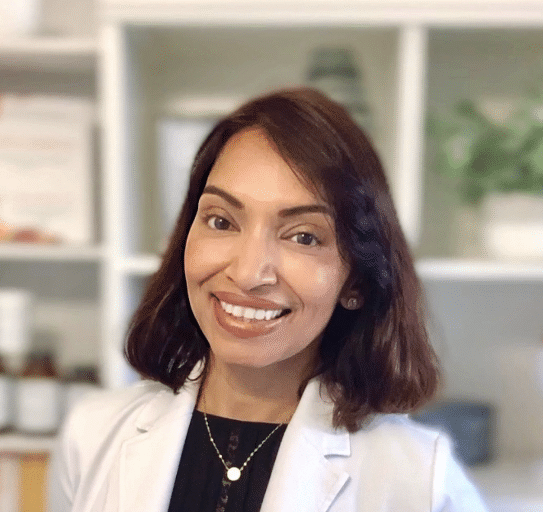
Dr. Rudrani (Rani) Banik is a board-certified ophthalmologist, fellowship-trained neuro-ophthalmologist, and Associate Professor of Ophthalmology at Mount Sinai.
Also certified in Integrative and Functional Medicine, Dr. Banik combines conventional care with care with nutrition and lifestyle strategies to support vision and systemic health. She has been recognized as a Castle Connolly Top Doctor and among New York Magazine’s Best Doctors annually since 2017. Her expertise has been featured on Good Morning America and in The New York Times and The Washington Post.
Dr. Banik is the author of Beyond Carrots and Dr. Rani’s Plant-Based Visionary Kitchen, founder of The Eye Summit™, a free online educational event, and host of The Eye-Q Podcast, bringing eye health education to healthcare professionals and the public through accessible, engaging, evidence-informed content.
Connect
Listen Now
Transcript
Dr. Sandi: Welcome to “Health Coach Talk.” Today, we’re talking all about the eyes, about vision health from conditions like glaucoma, macular degeneration, and then how to preserve your eyes with LEDs and blue light. And, yes, we talk about blue light blocking glasses. Is there any validity to wearing blue light blocking glasses? Do they help?
So, let me tell you about my special guest. She is a friend and colleague. She is Dr. Rani Banik, a board-certified ophthalmologist. She’s fellowship-trained as a neuro-ophthalmologist, and she’s an associate professor of ophthalmology at Mount Sinai. She’s also certified in integrative and functional medicine. And she combines conventional care with nutrition and lifestyle strategies to support vision health. I know you are going to get a lot out of my conversation with Dr. Rani.
Dr. Rani Banik, thank you for being with us. Welcome to “Health Coach Talk.”
Dr. Rani: Thank you so much for having me, Sandra. It’s such a pleasure to be here.
Dr. Sandi: So, let’s just jump right in and talk about vision, and what are some of the things that are commonly seen and maybe we’re told it’s just a part of aging and we get our eyes checked hopefully at least once a year. But what are some of the issues that you are seeing that people are facing in terms of things to watch out for and hopefully prevent as we get older?
Dr. Rani: Yeah. That’s a great question to start off with. I mean, there are so many things that can happen to our eyes as we get older, but there are some common ones, especially, I would say, 40, 45 and above, that tend to affect a lot of people. And they may not initially recognize it as an eye issue, but then over time they start to have symptoms and something’s not quite right. So, then they seek help.
But one of the common things is, most people, when we get into our late 40s, 50s, 60s, we have trouble reading. So, I don’t know if you’ve experienced this, but I certainly have, where you suddenly can’t perceive fine print, and you have to hold things further and further out. The official name is presbyopia, but I like to call it my arms aren’t long enough syndrome. You end up holding things like way out here.
And so, that’s something that happens because…and I’ll just pull out my eye model because I think it’s useful to have a visual to explain because the eye is…we only see the very front part of the eye, but there’s so much going on inside that we don’t see. So, it’s important to understand what’s going on as we get older.
So, let me take apart this eye model, and you can see here there’s a lot going on inside. But this is the cornea, just for reference. This is the curved structure in the front of the eye that focuses light. And we’ll come back to this in a moment when I talk about the next thing. Here’s the iris, which is the colored part of the eye. And here, it’s blue, but it could be green or hazel or brown, depending on your eye color. And this structure here, it’s like a disc shape. This is the lens. And the lens sits here, and it focuses light that’s coming in through the pupil onto the back of the eye. The lens is the issue in presbyopia.
So, what happens is, when we’re younger, this lens, it’s actually made of water and proteins, and specifically collagen. When we’re young, it is dynamic. It changes its shape. It helps us to focus. So, sometimes it’s thinner, sometimes it’s thicker, depending on what we’re looking at. So, if we’re looking at something far away, it’s a little thinner in the middle. If we’re looking at something up close, it gets thicker to help us focus. So, as we get older, this lens becomes stiff because the proteins in it start to create structures, and it becomes less flexible.
So, that’s why we develop presbyopia because when we’re looking up close, we’re trying to focus, and this lens isn’t changing its shape as it used to when you were like in our 20s, 30s, etc. So, that’s what presbyopia is. And there are many options for treatment. We can talk about that, and management.
But the other thing I wanted to point out is another very, very common thing that happens to our eyes as we get older is dry eye. I don’t know if you’ve experienced it, but I know I have, and many of my friends have, especially in midlife. It tends to affect women more than men. That’s when the surface of the eye, this cornea that sits right in the very front of the eye, it dries out. And when it dries out, we may feel like there’s sand in the eye, like a gritty sensation or pebbles in the eye or an eyelash. But it’s really the cornea getting dry. Or things may get blurry, or we start to have fatigue at the computer. You’re working and suddenly you just feel I can’t sit here anymore. And you think it’s something else, but it’s really dry eye.
So, those are some very common things that happen. There are others as well, but I’ll pause there in case you wanted to go a little bit more into any of those two, and then we can go into some other things as well.
Dr. Sandi: So, those are things that I think we’re going to talk more about. You have a unique approach in terms of an integrative functional medicine approach because what I hear when I go to my optometrist, they say, you’re aging. And I’ve been lucky because I really don’t…I just need the mildest reading glasses. And I’ve been wearing contact lenses since I was 15, which is a long time considering I’m 76. So, glasses since third grade. But I find that I can manage pretty well unless…the hardest thing are the supplement bottle labels. If I’m in a store and I like to read labels or products and where’s the ingredient list? And it’s really tiny print.
So, other than that, I can do pretty well in the restaurant. I’ll just check on my phone and have my flashlight and shine it and I’m able to see. But I know many people do struggle with…they struggle with dry eye. They struggle with cataracts. And I have been told this is just another normal part of aging. But there are…if you go online, if you…and I know people personally who have programs where you can change all this. Is that really possible to make an impact to improve our sight, especially as we’re getting older?
Dr. Rani: Yeah. I mean, I’m straddling the fence here because I still practice traditional ophthalmology. So, I do medical and surgical ophthalmology. And, yes, I love to do cataract surgery and help people fix their vision. But then on the other side, I’m definitely putting on my functional medicine hat and my integrated medicine hat, and looking at ways that people can integrate into their lives to help to delay symptoms or prevent things from happening.
And there are certain things that happen that are structural. Like I was saying, when this lens becomes less flexible, you can’t make it softer. Once it’s happened, you can try to stabilize it so it doesn’t get worse. Or if the lens becomes cloudy, that’s what we call a cataract. So, once it starts to opacify, you can’t reverse that opacification. When you get a freckle, you can’t just wipe it away. It’s in your skin. It’s melanin in your skin. So, it’s like that where a structural change can’t be reversed once it’s started.
But there are ways to prevent it from getting worse. So, even if you have an early cataract, you may not necessarily need to have anything done about it for years, for decades. Like you mentioned, you don’t look like you’re in your 70s. But I have patients who are in their 70s, 80s, 90s who have mild cataracts and they haven’t progressed because they’ve been able to use nutrition and use lifestyle strategies to try to prevent it from getting worse.
And so, it is possible. And I think that’s the disconnect between traditional eye care and integrative eye care. There is that bridge that needs to be there, that it’s not just one or the other. It’s a combination of the two. And we just have to meet the patient where they’re at. And some people will come in saying, just do my surgery. I just want to be fixed. And that’s one mindset. But then other people have a mindset where they’re saying, I want to do whatever is in my power to maintain my eyesight naturally as long as I can. And I fully support them in those ways as well.
Dr. Sandi: Such a good point. And I am definitely of the latter mindset. And I think that the health coaches who are listening or who wants to be a health coach, you can focus on the importance of preserving your vision. Good eye health is good overall health.
And so, I was recently at the optometrist. And for years, they’ve been saying, oh, you’re at risk for glaucoma and checking it. But it’s more like, oh, we’re just going to monitor it. And then if it gets worse, you’ll use eye drops and it’s no big deal.
I started doing some research and actually heard you on another podcast. And this was eye-opening because you were talking about inversions. And I thought, inversions. Every day, I’ve been doing headstands and handstands and shoulder stands and down long downward dog holds and so many…wow, could I be creating more intraocular pressure by doing all this? And then also started looking at what are some of the what’s been shown to potentially be helpful?
And so, I’m looking at what are boosting my polyphenols with blackcurrant and the tons…and see, well, okay, I’m not going to go into this without doing everything I can preventively. And is that something you see, whether it’s glaucoma, macular degeneration? Kind of knows many people who have been diagnosed with that. And so, with the functional medicine approach, it’s really root cause. And is the root cause the same as the root cause for heart disease, peripheral vascular, all these other issues that may be tied to the same root cause?
Dr. Rani: Yeah. Those are some great questions. I just want to point out what you said earlier about your optometrist saying, you may have glaucoma, you may be at risk, but let’s just watch and see. And then once it develops, we’ll prescribe some drops. I am very much against that. Eye care has been very reactive. We wait until something happens, and usually until someone actually loses vision before we do anything about it. Whereas there is research, and you were mentioning a few things that we can talk about nutrition-wise that can arrest vision loss, that can stop it from happening.
So, my mission now at this stage of my career is to educate my colleagues in eye care, optometrists, ophthalmologists. These are the things we need to be talking to our patients about. Don’t just let it happen, because once it happens, we can’t reverse it.
So, we’ll talk about glaucoma as a great example. Glaucoma, one of the major risks is high eye pressure. There are other risks as well, family history, myopia, things like that, but eye pressure is a risk. And we know that there are certain things that studies have shown that will increase eye pressure or potentially damage the optic nerve.
And when it comes to inversions, I always like to tell my patients, it’s not that you can’t do them. When you’re upside down, you just have decreased venous return, and your eye pressure will go up. It’s stay away from prolonged inversions. And if you’re doing it for 30 seconds, a minute, not a big deal. But if you’re doing it for…I don’t know what you tend to do, Sandi, but for peace…and there are some people who do it for extended periods of time, or they used to have those anti-gravity…
Dr. Sandi: Yes. Yes.
Dr. Rani: I had a patient once, and he thought he was doing a great health benefit to his body by doing the inversion. So, he would be tilted like this with his head down, his legs up for half an hour a day. And lo and behold, he was having this progressive damage to his optic nerves from glaucoma. And we couldn’t figure out because he would come to the office, his pressure was normal. Why is this happening? And then I asked him, what are you doing? What are your activities?
So, we have to think about things like that. What is the patient doing? Even things like…I’m very proactive when it comes to this. Even things like wearing neckties, like men who…I know neckties aren’t so much in fashion anymore, but men who would wear neckties to work, that extra pressure around their neck can increase their eye pressure. Or even swim goggles. I’ve had some patients who are avid swimmers and they wear…they’re protecting their eyes from chlorine. But if you’re wearing really tight swim goggles, that can also increase the pressure.
So, there are all these little nuances to our patients, their activities, what they love to do, their hobbies, their sports that we need to take into account. And of course, there’s diet. So, I’ll give you some examples.
With glaucoma, this is really interesting. So, there is a study done in a group of a cohort of African-American women over the age of 70. And this particular group is prone to glaucoma. They have a higher risk for glaucoma. And the study found…it was over 600, I think, patients in the study. They found that the women who were having two or three servings or fruit or more per day had a set, what was it, 72% lower risk of glaucoma progression. Two to three servings of fruit per day compared to the ones who had less than one serving per day.
And the other fascinating thing is black tea. So, another study found that people who had one cup of black tea per day, and it had to be caffeinated black tea, had a lower risk, also like 70% plus lower risk of glaucoma compared to people who didn’t have black tea per day, which was incredible to think that these small dietary changes can potentially protect our vision. And they’re not that hard to do, honestly. It’s not a big ask, I think. And plus, it helps other aspects of your health as well. It’s not just your vision that may be helped by eating more polyphenols, fruits and vegetables. You have other major benefits, cardiovascular health, skin health, brain health, immune system, GI health. So, it all goes together.
Dr. Sandi: It all goes together. Such a key point. And it’s fascinating. And I love what you said about the inversions, because, yes, it’s like, sometimes less is more. And often, if we’re high achievers, you tend to…okay. And years ago, I was doing that. How long can I hold a handstand? And I had to do it a minute a day or if I can get up a minute. And now, since I learned this, okay, I’m just…I count to 10 and I’m down quickly. And not straight.
Dr. Rani: If you were to do it for longer, like if you want to try it for that minute, go for a minute and then take a break. And then wait a while before you try it again. And that’s what I would say is just take breaks and don’t over exert yourself. That’s really key.
Dr. Sandi: Yeah. And I think that these are all such good strategies. And someone who is working with a health coach can really develop a plan. And often, if they’re saying maybe I’m going to give this up. So, I even thought, okay, if I give up inversions or doing them for so long, I’m going to do more wall squats and make sure I breathe with those wall squats or how you’re doing it. And similarly, I think with…and I love what you said about this, the prevention. And so, even things like macular degeneration, which scares a lot of people as well, can be headed off with.
Dr. Rani: Absolutely. I’ll say, macular degeneration, there are many…there are different stages of it. There’s intermediate, advanced. You don’t want to let yourself get too advanced because if you get to the advanced stage, that’s when there’s actually vision loss. So, early, you may not have any vision loss. Your vision could be 20-20, and you could still have early. Intermediate, maybe you start to notice a few changes, especially it’s harder to see at night. But advanced is irreversible, really. There are treatments available, which are monthly injections. And who wants to get an eye injection every month, right? It doesn’t reverse it. It just prevents it from getting worse.
So, why aren’t we talking about prevention? When it comes to macular degeneration, there are two important nutrients that some people may have heard of, called lutein and zeaxanthin. And they’re not like high profile nutrients. But when it comes to eye health, they’re superstars. Or beta carotene, cousins to vitamin A, and they protect the macula. They’re like our internal sunglasses, internal blue light filters. They absorb these harmful wavelengths of light. They neutralize those wavelengths of light. They fight against oxidative stress. They fight against inflammation.
So, we know from studies that if you eat enough foods with these nutrients, you can lower your risk of macular degeneration by 43%.
Dr. Sandi: Huge.
Dr. Rani: There is no surgery, no injection, no other treatment that equals 43% reduction in risk and protecting vision. And we’re not talking about it. It’s really a disservice to our patients. So, if you’re a health coach out there, I strongly advise that if you have a patient who’s worried about AMD macular degeneration, you share this study with them because it’s been out there for years. And, yeah, we just need to get the word out there.
Dr. Sandi: It’s so important. So, you mentioned nighttime driving. Let’s switch gears and talk about something that we hear a lot in the wellness community. And that is lighting, LED lights, blue lights, and these glasses. And you go on social media. I’m constantly seeing these ads for night…I find that so disruptive, the LED blinding headlights coming at you at night. So, what can we do, again, using a functional medicine orientation to…with LED, with blue light, our screen time?
Dr. Rani: Yeah. I’m going to go back to nutrition again. And so, there is no proof. Oh, I’ll say this first, then we’ll talk about nutrition. There is no proof that blue blocking glasses actually work. No scientific proof, which is shocking.
Now, some people may argue, but what about the sleep benefits? It helps me sleep. It helps me relax. That’s a separate issue. If you’re wearing blue blockers for sleep, for that kind of circadian rhythm, that is fine. But when it comes to…if you think it’s really protecting your eyes, most blue blockers are either clear or lightly yellow-tinted. And that’s only blocking 10% to 30% of the blue light. And that’s probably why the studies that use those blue blockers, they didn’t really show benefits.
Now, there haven’t been studies done using the darker blue blockers like orange or amber or red. I’d be curious to know what those studies show if they actually help against blue light. But what I tell my patients is, instead of buying these expensive blue blocking glasses, focus on nutrition. And we know that, again, lutein and zeaxanthin are the two nutrients that have been shown to decrease glare and light sensitivity when people are on screens, also improve just general comfort when you’re on a screen. And they can also help with dry eye. So, dry eye is also part of this green intolerance. We call it digital eye strain.
So, if you have enough lutein and zeaxanthin, great. You’re protecting your eyes. But sometimes it’s also helpful to take a supplement with lutein and zeaxanthin because that’s also been shown…supplementation has been shown to help with these blue light symptoms.
So, I would say, think about what you can do through diet and supplementation first. And if you’re still struggling, maybe get the blue blockers or…I actually…there’s a screen filter that you can download and put it on your devices, which actually will regulate the amount of blue light coming from your screen. And the screen filter will know geographically where you are. So, it’ll know when the sun is rising, when the sun is setting, and it’ll adjust the blue light coming from your screen, depending on your location and your time, which time zone you’re in.
So, that is actually very effective. I don’t know if you’ve heard of it, Sandi. It’s called Iris, iristech.co, I think, is the website. But it’s a free trial. It’s nominal. It’s not expensive at all. You can download it to your device, and it will regulate the blue light coming from your screen much better than any blue blocking glasses could.
So, that would be my suggestion. And then, of course, taking breaks. We’re talking about activities and taking breaks. I’m going to ask you, what do you…how many hours do you think the average adult spends on a screen every day? Take a guess.
Dr. Sandi: I would say it’s probably eight.
Dr. Rani: Yeah. Some studies have shown 7, and other studies have shown over 10. And this is pre-pandemic. So, now, probably it’s even more with more people working from home still. And kids spend about six hours a day on a screen, at least. So, both adults and kids, we have to take breaks. That’s not physiologically normal for us to be looking at a brightly lit screen and not looking outside, not getting sunlight exposure, like all of that. We have to go back to some of the basics.
So, I always tell my patients, follow the 20-20-20 rule. And we think of 20-20 is perfect vision. But the 20-20-20 rule is every 20 minutes, take a 20-second break, and look at something in the distance 20 feet away, or take a 20-second break and do some palming. Palming is a great exercise where you rub your hands together, generate some heat, and just cup them gently over your eye sockets, and don’t let any light come into your eyes. And that’s just a little reset you can do that can be so energizing. It feels so calming and refreshing. You can do a little meditation when you’re doing it. But there are ways to manage screen time, and it’s within our control, basically.
Dr. Sandi: I love that. That is so effective using that, and it just feels so good. And I think it’s also common where maybe we’re on our computer for work. What do we do when we take a break? We lift our phone or we’re at night, we’re watching TV. We’re still getting screen time. And so, it’s hard to step away from that. And I also find that…so, when we moved to a new location several years ago, they had installed some lighting and it was LED. And I hadn’t been…I just made them take them all out and replace it and found…and it’s getting…was getting harder to find and those…the incandescent. But I lived with that for 60 years, more than that. They were softened and using lamps with soft lighting as opposed to these really harsh overhead LED lights.
Dr. Rani: Yeah. LEDs, CFL bulbs. Yeah. They save energy. They’re better for our environment. But they emit a ton of blue light, a ton of blue light. And especially at night, we’re not…our eyes are not supposed to be getting that much blue light after the sun sets. So, yes, it can disrupt your sleep, your circadian rhythm.
So, the other thing I found is if it’s hard to find those incandescents, you can get smart bulbs. And it will actually change the tone of the color throughout the day. So, you can program it. So, during the day, it’s a cooler light that’s more blue to mimic the sun. And then in the evening, it becomes a warmer tone. So, more like orange, reddish slightly. And it’s so much easier on your eyes, and you can just pre-program it. So, they’re really helpful. They’re a little bit more expensive than the regular LED bulbs, but they’re really great for people who are trying to manage this light exposure and sensitivity.
Dr. Sandi: Yeah. I remember we did a late night run to Target or one of the big box…and the just blinding lights from everywhere. And that’s where I found I needed to have these glasses because it just needed to do something to cut out all that. And my husband recently had some ambulatory same-day surgery. And so, I was sitting in the waiting, and I thought, this is the worst light: fluorescence.
Dr. Rani: Horrible. And many people, they have them in their offices, the overhead offices. And they can’t work because there’s light coming from the screen. There’s light coming from above. It’s too much. So, I’ve actually had patients who have requested to change their station because they can’t sit under those bright fluorescence. And also in schools, most schools have fluorescent lights, too. So, we’re being bombarded by light. We really are. So, think about nutrition as your first to try to protect against it.
Dr. Sandi: Yeah. I think nutrition is so important. What about the other lifestyle factors? Movement, sleep, hydration, anything that would stand out as being really important.
Dr. Rani: All of that. Yeah. So, I mean, hydration. I’ve seen patients who get dehydrated and then they end up with vision loss because they’re just not getting enough oxygen or blood flow to their eyes and to their brain. So, I’ve seen that happen where they have different types of eye strokes because of dehydration, which is completely preventable. And then when it comes to sleep, I mean, we need to rest for our bodies, but our eyes need to rest also. We need to rest our eyes from that constant barrage of visual input that we get every day, whether it’s from screens or not. It’s a lot of processing that our eyes do, and we need to give it rest.
There are also…when it comes to sleep, I just want to mention, especially if there are health coaches listening, there are certain sleep disorders that can negatively affect our vision. And one main one is sleep apnea. So, people who have sleep apnea, they can have a host of medical issues. But what happens is their airway can actually close off at night, and they can stop breathing for microseconds. So, they have these small apneic periods throughout the night where they’re not breathing, they’re not getting oxygen to their tissues. And it’s a major risk factor for eye stroke. People can wake up…if they have sleep apnea, they’re not breathing multiple times during the night. They can wake up with a vision loss.
And I always ask my patients about this. Do you snore at night? Because your partners say that you snore at night. Do you ever wake up gasping for air? These are some questions to ask your clients or patients that may be amazing screening tools for sleep apnea. Because if someone has those…if they answered yes to those questions, then they should be screened and maybe treated. So, it’s really important to think about sleep and our eyes.
And you talked about movement. We know that for people who incorporate some degree of movement into their daily activities, they have lower risk of macular degeneration. They have a lower risk of glaucoma. They have lower risk of cataract. So, yes, movement is so important. And I’m not saying go out and do a triathlon. Even simply walking more, taking the stairs, or just sitting if you’re not mobile, doing some deep breathing or stretches, just trying to get more blood moving is so helpful. Little things. Little things make differences that can really move mountains when it comes to eye health.
Dr. Sandi: That is the key word. We can move mountains when it comes to eye health with little things, focusing on an approach that looks at all the aspects of lifestyle medicine and taking charge of your health before you get the diagnosis. And even when you get a diagnosis, know that there are still things that you can do.
This has been such an incredible time together. So much value packed into this short time. So, Dr. Rani, where can people find you?
Dr. Rani: Yeah. Thank you. First of all, thank you so much for having me. I mean, I’ve really admired the work that you do, and it’s wonderful to have this conversation to elevate eye health awareness. My website, drranibanik.com is the best place to find me. So, you can find…I have a podcast as well. I have a few books. I do telemedicine appointments in certain states. So, you can, if you wanted to reach out. And I also have a supplement line focused on eye health and migraines, if anyone’s interested in that.
Dr. Sandi: Check it out. This is very valuable for you and your clients. Thank you.
Dr. Rani: Thank you.
Health Coach Talk Podcast
Hosted by Dr. Sandra Scheinbaum
Conversations About Wellness Through Functional Medicine Coaching
Health Coach Talk features insights from the most well-respected names in health coaching and Functional Medicine. Dr. Scheinbaum and guests will explore the positive impact health coaching has on healthcare, how it can transform lives, and help patients achieve better health and wellness outcomes.

Check us out on these platforms: