The Oral Microbiome And Whole-Person Health, With Amanda Hale
What if your oral health is influencing far more than your teeth and gums? This week on Health Coach Talk, Dr. Sandi welcomes registered dental hygienist, biological oral health advocate, podcast host, and FMCA graduate Amanda Hale for a fascinating conversation about the connection between oral health and whole-body wellness. Together, they explore why the mouth deserves a much larger role in conversations about prevention, chronic disease, and long-term health.
“For too long, we have separated the mouth and the eyes from the rest of the health of the body, and you cannot have one without the other.”
Amanda Hale, FMCHC
After nearly two decades as a dental hygienist, Amanda began questioning conventional approaches to treating disease and became increasingly interested in root-cause medicine. Her training in biological dentistry and functional health transformed the way she viewed patient care, leading her to integrate health coaching principles into her work. Today, she is passionate about helping people understand how oral health, nutrition, mineral balance, lifestyle habits, and the oral microbiome all contribute to overall well-being.
Amanda shares insights on the oral microbiome’s relationship with gut health, the systemic implications of periodontal disease, and the ways oral tissues can provide clues about underlying health imbalances. She also discusses oral care products, pH balance, salivary diagnostics, mineral health, and practical strategies for supporting a healthier oral environment. For health coaches, this conversation offers valuable perspective on an often-overlooked aspect of wellness and highlights opportunities to help clients better understand the connection between their oral health and the rest of their body.
Watch The Episode
Episode Highlights
- Explore the surprising connections between the oral microbiome and gut health
- Examine how periodontal disease may reflect broader patterns of systemic inflammation
- Understand the role of oral care products, pH balance, and daily habits in supporting oral wellness
- Learn how health coaching principles can help patients take a more active role in their oral health journey
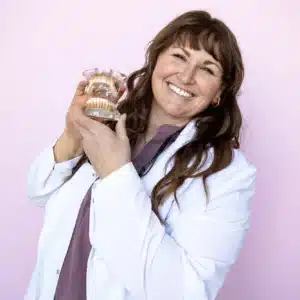
Amanda Hale is a registered dental hygienist with over 18 years of clinical experience and a strong passion for patient-centered care. She is HIAOMT-accredited through the International Academy of Oral Medicine and Toxicology and is the host of Functional Roots: The Biological Hygiene Podcast (formerly co-host of Hygiene Elevated). Amanda serves as a professional educator and Key Opinion Leader for oral care brands and has contributed to RDH Magazine and Dentistry IQ with a focus on bridging oral health and whole-body wellness.
Most recently, she completed her health coaching program through the Functional Medicine Coaching Academy in partnership with the Institute for Functional Medicine and has earned her NBC-HWC credential. Now, she’s stepping into her next chapter—finding creative, real-world ways to bring these tools to life and help patients transform their oral health as part of their overall wellness journey.
Connect
Listen Now
Transcript
Dr. Sandi: Welcome to another episode of “Health Coach Talk.” Today, we are talking with Amanda Hale. And she is an oral hygienist, who also happens to be a health coach. We typically don’t connect oral hygiene with health coaching, but this is Amanda’s mission. Let me tell you a little bit about her.
She is a registered dental hygienist with over 18 years of clinical experience and a strong passion for patient-centered care. She is HIAOMT-accredited through the International Academy of Oral Medicine and Toxicology. And she’s the host of “Functional Roots,” the biological hygiene podcast. She serves as a professional educator and a key opinion leader for oral care brands, and has contributed to RDH Magazine and DentistryIQ with a focus on bridging oral hygiene and whole body wellness. I know you are going to get a lot out of my conversation with Amanda.
Amanda, welcome to “Health Coach Talk.”
Amanda: Thank you, Dr. Sandi. I am excited and honored to be here.
Dr. Sandi: Well, we’re honored to have you and honored to have you as now a graduate of Functional Medicine Coaching Academy. And tell me, how did you decide to become a health coach? Because you didn’t start out in health coaching. But can you share that decision to become a health coach as a hygienist?
Amanda: Yes. So, probably a little bit different than everybody else in my class. Definitely, it was an interesting, diverse background of people that were in my cohort. But I’ve been a registered dental hygienist for about 18 years, which just is insane to say. I’ve been direct clinical care, and I think COVID did a lot to really start to change how I viewed and how I really was looking at the treatment of disease and the disease process, and really started to take the biological approach, which the counterpart to that on medicine side is functional health.
So, I became a biological dental hygienist. I got involved with that side of dentistry through the International Academy of Oral Medicine and Toxicology. And it just really became a paradigm shift in how I viewed disease and disease process, and how I was treating patients. But I just wanted to do more and be more effective as a clinician and looking at ways to be able to utilize my profession, my experience, virtually. And so, trying to grow my knowledge base and learn more about the functional side of health and working to integrate oral systemic health. Because, for too long, we have separated the mouth and the eyes from the rest of the health of the body, and you cannot have one without the other.
Dr. Sandi: That is just a fascinating journey. And the two really go so well together. And I remember having a conversation with a hygienist a while back and she said, we have them in the chair. This is a gift. People will go see their dentist and they’ll go for a cleaning much more than they will go to, let’s say, the primary care doctor.
Amanda: Yes. Very interesting fact with hygienists on that note, Dr. Sandi, hygienists are the only health care provider that gets an hour with a patient.
Dr. Sandi: That’s right.
Amanda: No other, like your nurse practitioner, your pharmacist, nothing. Even a functional provider, often you’re not getting an hour with your provider, maybe cumulatively. But we do have a very unique position in how we’re able to really connect with our patients, especially on a community level. And that’s what I’ve loved about what I do for the last 18 years.
Dr. Sandi: Now, how are you bringing health coaching into your work?
Amanda: So, there’s a few ways. So, I still practice clinically for my dental office that I’ve worked at for the last five years. So, a couple of ways I’m integrating into my practice is really doing more of the motivational interviewing. How do you feel that you can be successful? So, really working on how I’m able to make recommendations. I have the recommendations, but what’s going to be successful is how my patient is going to be able to implement them. So, exploring options, visualizing, and really helping them to be more in the driver’s seat of their oral health. And we know you can lead a horse to water, as it were, but really helping them to vision health for themselves. What do you visualize as health for your mouth and for your teeth? Because a lot of people just get into the routine of I’m here for my cleaning. She’s going to polish, she’s going to floss, and I’m done.
So, really changing conversations and helping them to connect the fact that their mouth is connected to their body. Maybe the medications that they’re taking or supplementation that they’re taking is having impact. So, really changing conversation and trying to engage my patients in their health are some of the ways. I’ve started doing on another aspect of things. I’ve started doing hair tissue mineral analysis, which HTMA, I’m sure many of our listeners are aware of what HTMA is. The mouth and the teeth are the biggest mineral reserves that we have in our body. So, if we’re seeing evidence of decay, it’s not just that there’s a fluoride deficiency, right? That’s how it’s been treated in dentistry for so long. It’s a sign of something else that’s going on. Women lose, on average, eight pounds of mineral per pregnancy. Eight pounds. That’s a lot. And so, that’s…we have to work to balance those minerals.
So, that’s something I’m working on. I have a couple of clients now that I have been able to help break down some of the calcium shell patterns. It’s a fascinating world. Just the minerals. We don’t think about it. I think we’re just so used to status quo that we really aren’t in the space that we are minerals and we are vitamins. Everything that we’re consuming is the future building blocks for ourselves. We know we have a new skeletal system every 10 years. That includes our teeth and our gums and our bones. So, how we can make those changes now is going to affect our future self and our future disease process and health outcomes.
So, there’s just so much that can be done to educate clinical, but also social media, whatever platform any clinician has. So, that was a very roundabout way of how I answered your question, Dr. Sandi. But there’s quite a few ways that I’ve worked to implement what I’ve learned in the Functional Health and Coaching Academy to really impact patients’ lives, and hopefully make some changes for them as well.
Dr. Sandi: It just seems that there’s so much synergy with oral hygiene and health coaching. So, for those listening, and we have many people listening who are health coaches or intending to become health coaches or wanting to see a health coach, how can health coaches start to add content or question people regarding their oral hygiene, and bring this into their work as health coaches? Because sometimes they don’t always think about the health of the mouth when we think about what a health coach will do. We’ll think, well, they’re going to focus on nutrition and movement and sleep, for example. But what about oral hygiene? What can health coaches really do?
Amanda: It can be something overwhelming. Something patients always tell me is, “Ugh, how do you deal in the mouth all day?” So, this has just been like a no-go zone for healthcare providers, but also for patients. People are grossed out by teeth. So, it’s a very good question.
There’s a lot of ways that our oral health can be addressed without ever having to dig into the mouth. So, one of the ways I think health coaches can be more educated as a coach, I guess, is the use of products. If you take a walk down any grocery store, any supermarket, it’s overwhelming the amount of products and options that there are anymore. And they all make different claims. But the toxicity level between heavy metal ingredients, which if you…I think everybody that was listening is probably on the same page. We know fluoride is not great for our bodies. In dentistry, it’s hotly contested. Fluoride is a neurotoxin. But it does…in fact, it hardens enamel. I won’t argue that at all. But it displaces iodine and iodine is critical for thyroid health. So, how can we as hygienists and as oral care professionals ignore the impact that it has systemically?
So, that is just one example. But there are alternatives out there. Hydroxyapatite-based toothpaste, which are not going to be found in your big box stores, or I should say very few. And are they good high quality? That’s just one example. There’s plenty of other ingredients that are very toxic. We don’t think about the fact that our tissues are highly vascular. So, they can absorb so many products quickly. And that can be nanoparticles. It can be red dyes, blue dyes. You think about all of the mouthwashes out there, how brightly colored everything is. Well, we know that gets absorbed into our tissues and it does create an endocrine-disrupting mechanism.
So, there’s quite a few aspects that just knowing products and ingredients that health coaches can have. And I would love to continue to be a resource knowing that it’s a Wild West out there to continue to help and even provide education for health coaches. What should they be looking for? What are things that they could…I don’t say recommending, but guiding patients towards looking for cleaner ingredients because we know there’s greenwashing out there. That’s a term that we’ve heard. Just because it says organic or natural, it doesn’t mean that it’s safe, effective, or good for us.
On another page… I could talk about hygiene all day long in products because this is my wheelhouse. A lot of things is pH. A lot of people are not familiar with what’s called the pH scale. And that’s the scale of how basic or acidic anything is. A lot of dental products are on the acidic side of the scale. This scale goes from 1 to 14, and 7 to 8 is considered neutral. Well, a lot of mouthwashes, again, that you find in big box stores that we’ve associated with fresh and clean and healthy for so long, we’re finding out that those mouthwashes are creating dysbiosis. And that’s an imbalance of good and bad bacteria. Well, guess what? This is where our bacteria seeds down into our gut. So, if we’re annihilating the good bacteria and promoting an environment where that bad bacteria thrives, it’s going to get into our gut and help to see that dysbiosis problem that so many people have.
But on top of that bad bacteria…excuse me, not the bad bacteria, but the more acidic and shotgun approach to killing bacteria, well, it also kills nitric-oxide-producing bacteria. And we know nitric oxide is where we’re getting that smooth muscle promoting action in our body. So, nasal breathing. There’s just so many elements to oral health that health coaches can really help to guide their patients with. So, yes, there’s a lot that health coaches can learn and know. And I can break that down as well.
Dr. Sandi: This is such important information. Let’s also talk about…you mentioned dysbiosis. And we think of the gut microbiome, but there’s also an oral microbiome. And I’m assuming, this is also another area that is critical and health coaches can help people give them education, help people understand this oral microbiome that we all have.
Amanda: Yes, absolutely. It’s absolutely critical. Like I mentioned, the mouth kind of seeds that gut microbiome. There’s a skin microbiome. Our skin is part of our…essentially, our integumentary system as well. So, it is all connected. In the mouth, there is…commensal bacteria is what we call in dentistry. So, there’s bacteria that seeds disease or seeds health. And the products that we recommend or what we use are either going to help to feed the good guys or feed the bad guys.
And so, creating that environment where the good guys can grow is much, much more conducive to a healthy, balanced oral microbiome. And it’s also going to have a downstream effect of a healthy gut microbiome as well. Like I mentioned, with the main products that are used by the majority of people because of marketing, it drops that pH and it’s…like I said, our enamel starts to demineralize at a pH below 5.5. And if you can do a simple Google search of whatever products you’re using, what is the pH of…and I’m not going to drop any specific names of products. But it’s very empowering for patients to know, what are you using and what is that product having an effect on that oral microbiome?
To counteract that, there are wonderful oral probiotics that you can use that are going to help to replenish that oral microbiome that, again, of course, are going to have a downstream effect. But as I think we all know from the Functional Medicine Coaching Academy and the Institute for Functional Medicine, diet is always the best way to feed and seed those good guys and create a better health situation for our mouth, but also for our whole body. Because what benefits the mouth is going to benefit the body, of course.
Dr. Sandi: So, so true. Conditions begin in the mouth. For example, gum disease. And there can have a systemic effect. And of course, in functional medicine, we look at systems biology. So, can you discuss how the condition of our mouth may be reflecting something going on systemically or can lead to systemic issues?
Amanda: Okay. So, I get to be in the coolest group of biological hygienists. And one of my friends just released her book yesterday, Lani McBeth. Highly recommend it. She released a book on just the tongue and all of the systemic conditions that you can see. One of the biggest things, it’s a condition that we call benign migratory glossitis or geographic tongue. Gut dysbiosis absolutely will be evident in your oral mucosa, specifically your tongue.
So, one of those things, again, celiac disease. If you’re having malabsorption issues, you are going to see it in the oral mucosa, specifically the tongue. And a lot of people think, oh, this is normal. And they just aren’t connecting what the mouth is to the rest of the gut. You discuss periodontal disease. And periodontal disease, we’re really starting to finally say the word autoimmune when we talk periodontal disease, because it is a loss of bone and soft tissue as well.
And the longstanding tradition in dentistry was that it has been bacterial in nature, which it is true. There is definitely periodontal pathogens that are present in that disease that get into your bloodstream, not only get into your gut, but they get into your bloodstream. And they have found these periodontal pathogens in just about every type of disease, whether it’s Alzheimer’s brains, preterm low birth weight babies, pancreatic cancer, upper respiratory infections, bacterial endocarditis. You name it, you’re going to find a lot of these. It’s about six keystone periodontal pathogens that get into your bloodstream and just go haywire that create the inflammatory process.
Well, we’re starting to kick back a little bit and say, yes, this bacteria is absolutely horrific. It’s horrible. But why can your body not fight it off? The other side of that coin is it…that your body is already inflamed and irritated and not able to actually fight it. And why is it turning on your immune system? So, we call it the germ terrain theory. Is it the bacteria or is it that your body is already compromised and not able to effectively fight that off? Because we see a lot of crazy things in dentistry. We will see people with plaque, horrible hygiene, but maybe they just have a better constitution. They maybe have just a better diet, but they’re not…they don’t clean their teeth as well. But we just don’t see that bleeding, that redness, that inflammation. The body hasn’t decided that bacteria is bad.
So, it’s very interesting. There is many thoughts out there, but there is quite a few very interesting things that we can see, conditions that we can see orally that give us a lot of clues, especially in the gut. Not to mention smells.
Dr. Sandi: Oh, absolutely. So, what, in your opinion, is an optimal hygiene regimen? So, what do you tell your patients regarding how to take care of their teeth? In their mouth, I should say. It’s not just teeth. It’s their mouth.
Amanda: Ideally, salivary diagnostics are huge because one size doesn’t fit all. Everybody, it’s not like I would just recommend…or my doctor wouldn’t just recommend a blanket supplement for everybody. What do you need? And I think salivary diagnostics in the perfect world let you know what bacteria do you have because we don’t want to go overboard and kill everything. So, I think being able to customize is the best way.
But if I was to just meet somebody off the street and they were to ask me, what do you recommend? I’m a huge fan of oil pulling. There’s many benefits to it. We actually do have to be careful. Dr. Mark Burney [SP] actually put out a really interesting article recently about how coconut oil, raw virgin coconut oil is actually a little too antimicrobial, and it can mess up the microbiome. So, MCT oil is a little bit more mild. Even though it is still coconut oil, it is just the medium chain. So, there’s not as much lauric acid. So, it’s a little bit more mild on the bacteria. Also, coconut oil has a pH of eight. So, it’s fantastic.
So, on that note, I think starting your day with oil pulling is really good because you do also get lymphatic movement in your face. Nobody thinks about the lymph in your face. So, gua sha, but coconut oil pulling is a great way to start the day. Brushing. I like an electric toothbrush. I think electrics are fantastic because it’s built in accountability because we’re so distracted these days. So, two-minute timers on electric toothbrushes, I think, are phenomenal accountabilities. And then a great non-toxic toothpaste. I’m not going to put any in there. I do use something that has nanohydroxyapatite or a hydroxyapatite that has been studied by the SCCS, which is the Scientific Council on Consumer Safety in Europe. So, there’s only a handful of products in the United States that I use personally. I don’t use a mouthwash. That’s my morning routine. Nighttime, I do floss and brush before bedtime, and tongue scrape. Absolutely. Copper tongue scraper is my favorite.
Dr. Sandi: When do you tongue scrape?
Amanda: Morning and nighttime, absolutely. I don’t feel clean…I can floss and brush, but if I don’t scrape my tongue, I don’t feel clean.
Dr. Sandi: Do you do it before or after you brush? I’ve heard to do it before or first thing in the morning before you drink water.
Amanda: Yes. Before you drink water. I think oil pulling absolutely before you do any of that because it’s pulling out those toxins. And especially if you have an oil that has sesame oil in it, it helps to reduce the oxidative compounds, those ROS species that bacteria produces. It has antioxidants in it just to help those tissues. And especially if you are prone or you have a client that’s prone to periodontal disease, they’re going to have a lot of this. So, oil pulling first thing in the morning. And then you can either tongue scrape or floss, hey, whichever you want to do, and then brush. Just getting rid of that bacteria in a methodical, systemic way. Consistency is key. But whatever patients are actually going to implement is best.
Dr. Sandi: So, so true. I’ve also heard recommendations for water floss. And I was wondering your thoughts on that.
Amanda: I do love a water flosser. I love a couple of things about a water flosser, because if your microbiome is imbalanced and you have dysbiosis, it’s a great opportunity to add an antimicrobial into the water flosser. Something I always tell patients, when you have a water flosser where there’s moisture, there’s bacteria. If you are not keeping that dry and clean, you can get an infection. You can get Legionella from that. I have had a patient that had that happen to them. They were moving and they did not dry out their water flosser. They moved to their location. It was like a month later. It was a bad situation. So, you do have to be careful with that.
But I get that question a lot. And my answer specifically about why a water flosser, overfloss, which one’s better? What’s my opinion? There’s biofilm, which is very sticky, and that stickiness doesn’t care about a water flosser. That water flosser is not going to get that sticky biofilm off. It needs floss. It needs mechanical disruption. Now, there are bacteria called spirochetes that are not sticky. They are not on the tooth. They’re a little bit more out in the tissues, loosey goosey, if you will. They’re not stuck onto the tooth. Those guys, they’re bad guys. They don’t care about floss. They need to be flushed.
So, I think it’s very specific to what your microbiome is composed of. Again, whatever a patient is actually going to use, something is better than nothing. But if we’re really trying to get specific about, okay, what bacteria do you have? What is your biofilm? Let’s really focus on, can we put some antimicrobials in there to help to get rid of this bacteria and to make your oral hygiene more effective? But just balancing that oral microbiome.
Dr. Sandi: This has been just so, so informative. And I know that our listeners have learned a lot. And I think this is an area where you just get tons and tons of questions. I remember years ago, there…and she’s still on the faculty at IFM, Institute for Functional Medicine. And after her talk…she was a biological dentist. And people just surrounded her with questions. And it seemed like there’s so much that we want to know about this topic, but it is also something that’s not that talked about. So, I really applaud your work for bringing this to the forefront, for educating. And of course, health coaches can be the ones that are part of this. So, I’m so glad you made that decision to become a health coach. And you are so passionate when you speak about this. And so, I just want to thank you for being here. But before we close, tell us where people can find you and tell us what your future plans may be.
Amanda: Future plans. Honing in, I definitely want to continue to hone in the skills and really start to tie in the HTMA testing and really just grow that knowledge. I have been admitted into the master’s program at the University of Utah for the Masters of Business Administration. As of now, I intend to go forward with that. I’m nervous about that step, but I really love the health and wellness space, and I want to see this grow. I love this industry. I love that it’s the root cause and the functional approach to health and not just masking it.
I do have a podcast as well that I get to do with my friend Heather that does salivary diagnostics with Bristle Health. And we are “Functional Roots” podcast. You can find us everywhere. I’m on Instagram as thecurvyscaler. It’s a very niche name. And then my website is Sequoia Collective. I’d love to be a resource for your listeners. For anybody out there, I post content. I’m in the middle of a Mineral Mondays series, but I just share my life as a hygienist, my journey as a biological hygienist, funny things that happen in clinic, and just relatable content. So, yeah, it’s just me.
Dr. Sandi: Wonderful. Well, you are a joy to speak with. I know that our listeners have learned so much. So, thank you so much for being with us, Amanda.
Amanda: Thank you, Dr. Sandi.
Health Coach Talk Podcast
Hosted by Dr. Sandra Scheinbaum
Conversations About Wellness Through Functional Medicine Coaching
Health Coach Talk features insights from the most well-respected names in health coaching and Functional Medicine. Dr. Scheinbaum and guests will explore the positive impact health coaching has on healthcare, how it can transform lives, and help patients achieve better health and wellness outcomes.

Check us out on these platforms: